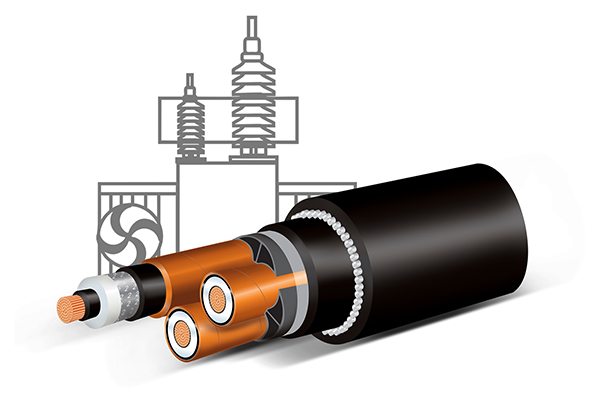
Paper-insulated lead cables (PILC) have been in use for more than 100 years in medium-voltage (MV) applications ranging from 6.6KV up to 36KV, and on the odd occasion they are used in high-voltage systems as well. PILC has been preferred over the years due its high dielectric strength, low dissipation factor, relatively low dielectric loss, low sensitivity to direct current (DC) testing, and proven reliability. PILC has become less popular over the years though, with it being replaced by cross linked polyethylene (XLPE) due to factors impacting its cost-effective use. Many cable manufactures around the world have discontinued PILC due to the related reduction in demand as a result.

Electrical engineer Donemore Torerwa, who is General Manager: Product Development & Applications at leading manufacturer Aberdare Cables, says, “XLPE as an insulating medium has a lower dielectric constant, lower dielectric loss, high dielectric strength, and operates at higher temperatures. This allows the cable to be more efficient when carrying far more current than the same size PILC version. Generally, XLPE is preferred by customers for factors to do with ease of use, efficiency, less complexity when it comes to using accessories and more.”
Below are a few reasons why XLPE is chosen over PILC for MV cable insulation:
XLPE has a higher current rating compared to the same size PILC cable due to XLPE having a higher operating temperature.
Installation, maintenance and repair processes are more complex, intensive, timeous, and costly for the PILC version, which makes XPLE the better business option.
Accessories such as jointing and termination kits are not easy to locate as many factories worldwide have discontinued paper cable production.
There is a significant skills shortage for splicing, jointing and termination of PILC which as a result leads to an increase in the number of PILC failures due to suspected poor workmanship.
Although PILC has been somewhat better at providing radial water blocking properties with the lead sheath, which is completely impermeable, XLPE is also available in cost-effective water blocking formats for both longitudinal and radial water blocking upon request. Aberdare Cables is one such manufacturer that can adapt products to suit client needs.
XLPE cables are more flexible compared to PILC cables that increase in rigidity as the size of the cable increases. XLPE can therefore be used easily where shorter bending radius is required.
Paper-insulated lead cable is oil impregnated with mineral oil or PIB and has a lead sheath (heavy metal) that increases the risk of environmental contamination. XLPE is favoured where an environmental analysis is considered as a key consideration for design decision.
“Aberdare Cables offers XLPE cables up to 132KV for customers across Africa and around the globe,” says Torerwa. “For voltages higher than 132KV, XLPE cables can also be provided by Aberdare Cables through its parent company Hengtong Group in China.”
Enquiries: www.aberdare.co.za